
Explore the Arts. Express Yourself.
Your creativity. Your voice. Your art.
Reflections is a national arts program that gives Edgewood students the opportunity to create original artwork, share their ideas, and earn recognition for their creativity.
Open to ALL Edgewood students — Middle School & High School.
Deadline to submit is October 16, 2026.
No late entries will be accepted.
Or drop your entry form off at the front office.
What is Reflections?
Your art. Your ideas. Your opportunity.
For more than 50 years, the National PTA Reflections program has encouraged students to explore their creativity through the arts.
Each year, students create an original work of art inspired by the annual theme. Entries are reviewed for creativity, interpretation of the theme, and technical skill, with opportunities for recognition at multiple levels.
This year's theme:
“What My Culture Means to Me”
Whether you're an experienced artist or you've never entered an arts competition before, Reflections is about expressing what the theme means to YOU.
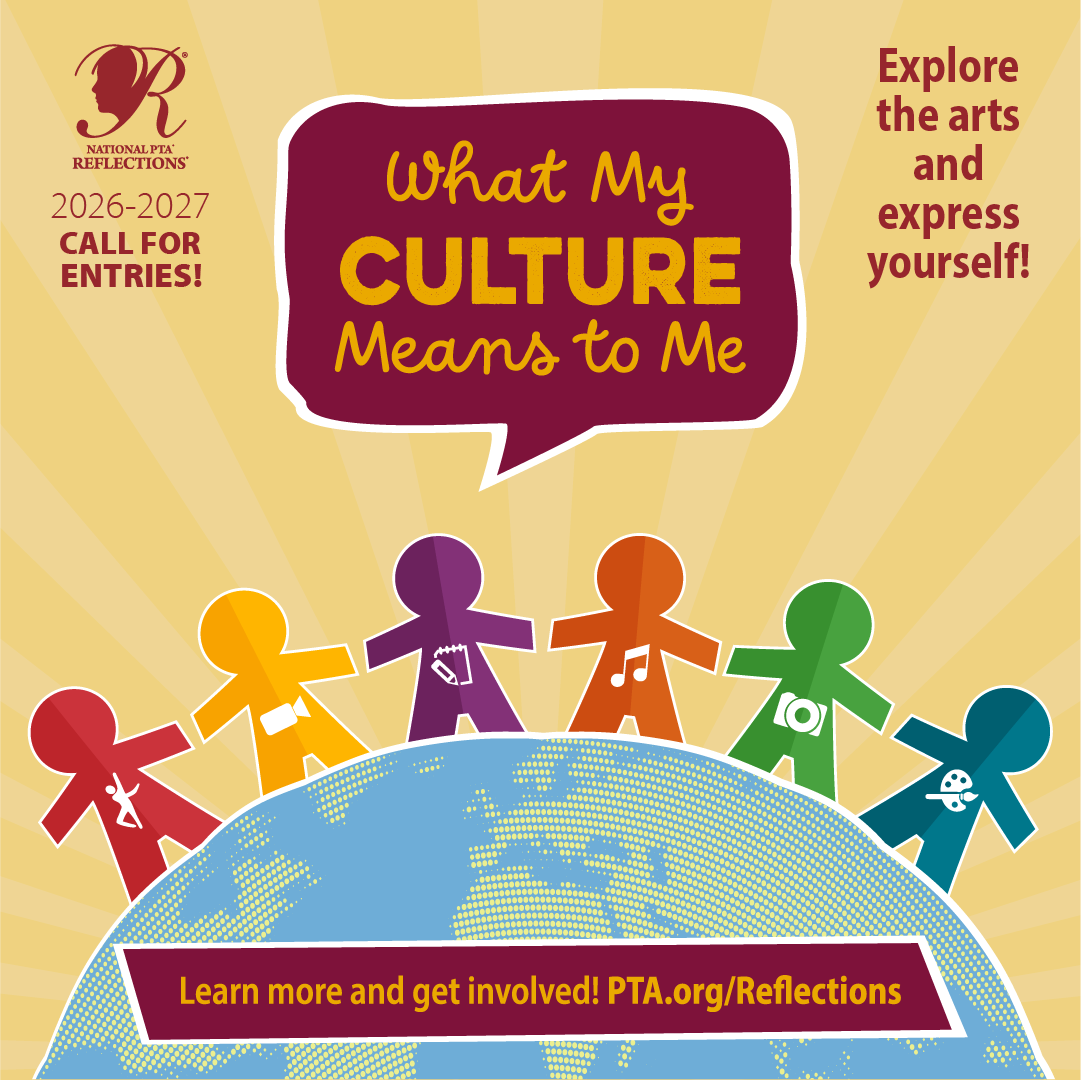
Choose your creative lane.
Students can enter artwork in one or more of these categories:
What Can I Create?
Create and submit an original dance.
Or drop your entry form off at the front office.
DANCE CHOREOGRAPHY is the act of creating movement, usually coordinated with music, to represent an idea through dance (e.g., your interpretation of the Reflections theme).
Portray Your Original Choreography
Consider the following styles and ensembles, Ballet, Contemporary, Hip Hop, Jazz, Tap, Folk Dance, Religious Dance, Dance Ensembles (color guard/indoor guard), Ice Skating/Dancing and Gymnastics-Floor Routine.
Show clear relation between choreography and the theme with choreographic style and techniques, background song(s), props and the location to show a clear relation of the dance choreography to the theme.

Capture your interpretation of the theme through photography.
Or drop your entry form off at the front office.
PHOTOGRAPHY is the process of creating an image. By focusing on objects using various lenses, filters and light sources, photographers may demonstrate the use of photographic techniques conventionally or digitally. Collages and collections of photos are not accepted.
To Portray Your Original Artwork
Consider the following accepted forms of photography: a single photo, panoramic, photomontage (one print of multiple original photos), a multiple exposure, negative sandwich or photogram and original black-and-white and color images.
Avoid the following unaccepted forms of photography: entries with added graphics and/or non-photographic elements (e.g., lettering, icons), collages and collections of photos, original film (negatives or transparencies) and multidimensional pieces.
To show a clear relation of the photo to the theme, use objects, lighting and the location.
Create an original drawing, painting, collage, digital artwork, or other visual art.
Or drop your entry form off at the front office.
VISUAL ARTS includes many art forms that are visual in nature. Through combined elements like color, shape, and texture, visual artwork is not only pleasing to look at but also expresses an idea or thought. Collections are not accepted.
To Portray Your Original Artwork
Consider the following accepted forms of visual arts: Architecture (2D/3D), carpentry, ceramics, collages (combined non-photographic and/or photographic elements), digital art and graphics (drawings/paintings/illustration), crafts, design, dioramas, drawing, fiberwork, jewelry, kites, metal etching/punch work, mobiles, painting, printmaking, sculpture and wind chimes.
Avoid the following unaccepted forms of visual: Reproductions or enlargements of other artwork are not accepted.
Show a clear relation to the theme using art form, use of color, texture, shape, proportion etc. to show a clear relation to the theme.
Express yourself through poetry, fiction, essays, stories, or other original writing.
Or drop your entry form off at the front office.
LITERATURE is the art of writing. The author (e.g., student submitting the entry) is a person who expresses their own thoughts and ideas through the use of words. Collections of literary work, such as multiple poems or short stories are not accepted.
To Portray Your Original Writing
Consider the following literary styles, Prose, Poetry, Drama, Reflective Essay, Narrative, Short Story.
To show a clear relation to the theme, use fiction or non-fiction, plot and characterization, setting and imagery, style, symbolism, etc.
Create an original musical composition.
Or drop your entry form off at the front office.
MUSIC COMPOSITION is the process of creating a new piece of music. The composer (e.g., student submitting entry) is a person who expresses their own thoughts and ideas through the use of sound. Entries in the middle and high school grade divisions must include music score/notation.
To Portray Your Original Composition
Consider the following musical styles and instruments, A Cappella, Blues, Choral, Country, Electronic, Hip hop, Jazz, Latin, Musical, Orchestral, Pop, R&B, Religious, Rock, Symphonic/Concert Band and Traditional.
To show a clear relation to the theme, use structure, melody, rhythm, instruments, lyrics, emotion, etc. to show a clear relation to the theme.
Explore new methods and make use of instruments, sounds, styles and combinations. All are accepted.

Tell your story through an original film.
Or drop your entry form off at the front office.
FILM PRODUCTION is the process of making a film. The producer (student submitting the entry) is not required to appear in the film but if the student chooses a tripod may be used. All screenwriting, directing and editing must be done by the student producer. Digital slide presentations (PowerPoint) are not allowed.
To Portray Your Original Film
Consider creating your film in using the following styles:
Animation: Demonstrates motion by sequencing still objects or using computer-generated graphics.
Narrative: Tells a fictional story developed by the student.
Documentary: Presents facts and information.
Experimental: Explores movement, light and montage.
Multimedia: Uses a combination of different contents (text, audio, still images, animation, etc.).
To show a clear relation to the theme, develop a work of fiction or nonfiction and make use of plot and characters, visuals (setting, costumes, animation), sound and background music, editing, etc.
Or drop your entry form off at the front office.
ACCESSIBLE ARTS Division is an option for students who identify as having a disability and may receive services under IDEA or ADA: Section 504. The division welcomes students of all ages and offers division-specific accommodations to ensure that every student has the chance to participate fully in the program.

HOW IT WORKS
Creating your entry is simple.
1. CREATE
Choose a category and create an original piece inspired by “What My Culture Means to Me.”
2. PREPARE
Review the entry guidelines for your category and make sure your work meets the requirements.
3. SUBMIT
Submit your entry virtually through our online submission form or via a physical form turned into the Edgewood front office.
4. GET RECOGNIZED
Entries are reviewed through the Reflections process and may have opportunities to advance for additional recognition.
Ready to Submit?
You've created it. Now let's see it!
OPTION 1 — SUBMIT ONLINE
The easiest way to submit your Reflections entry.
OPTION 2 — DROP IT OFF
Prefer to submit in person? No problem!
Complete the required form linked below and bring your entry to the Edgewood front office.
QUICK FAQ
-
All Edgewood students in grades 6–12 are welcome to participate.
-
No! Reflections is about creativity and self-expression. You don't have to consider yourself an artist to participate.
-
Yes. Students may enter artwork in one or more available arts categories, subject to the program guidelines.
-
Follow the current Reflections entry guidelines for the number and type of entries allowed.
-
You can submit virtually through our online form or turn your submission in to the Edgewood front office.
-
That's completely okay! You can submit your work in person through the front office.
-
Your work should be an original creation inspired by this year's theme: “What My Culture Means to Me.” There are many ways to interpret a theme, so make it meaningful to you.
-
Entries are reviewed using the Reflections criteria, including interpretation of the theme, creativity, and technical skill. Selected entries may have opportunities to advance for additional recognition.
Need More Help?
Not sure where to start?
National PTA has helpful resources for students, families, and program leaders, including:
Entry & category guidelines
Tips for creating your artwork
Theme interpretation ideas
Artist statement guidance
Review criteria
Accessible Arts information